
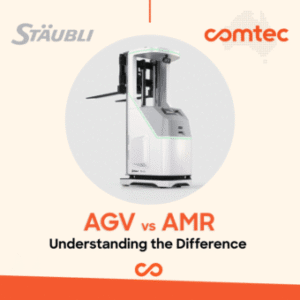
As factories and warehouses move toward Industry 4.0, mobile robots have become essential tools for improving efficiency and reducing manual handling.
Two main technologies dominate this space: Automated Guided Vehicles (AGV) and Autonomous Mobile Robots (AMR).
AGV (Automated Guided Vehicle):
A robot that follows a fixed, pre-defined route in a facility, such as a magnetic strip, wires, or floor markers. Its path and tasks are planned in advance.
AMR (Autonomous Mobile Robot):
A robot capable of navigating autonomously through its environment using sensors (LiDAR, cameras), mapping (e.g., SLAM), and dynamic path planning without relying on any installed guiding infrastructure.
While both automate material transport, they differ significantly in how they navigate, adapt, and integrate into production environments. Understanding these differences is key to choosing the right solution for your operation.
AGV:
Require fixed paths or guiding systems (wires, magnetic tape, or optical markings). They need significant infrastructure setup, and changes to the route often mean reinstallation or modifications.AGV (Automated Guided Vehicle):
A robot that follows a fixed, pre-defined route in a facility, such as a magnetic strip, wires, or floor markers. Its path and tasks are planned in advance.
AMR (Autonomous Mobile Robot):
A robot capable of navigating autonomously through its environment using sensors (LiDAR, cameras), mapping (e.g., SLAM), and dynamic path planning without relying on any installed guiding infrastructure.
AGV:
Best suited for environments with stable, predictable workflows and fixed routes. They are less adaptable to changes in facility layout, process flow, or variable tasks.
AMR:
Perform best in dynamic, changing environments such as e-commerce, multi-product factories, and hospitals. Their software-driven navigation allows quick repurposing, new route definitions, and easy fleet expansion without heavy infrastructure work
AGV:
Best suited for environments with stable, predictable workflows and fixed routes. They are less adaptable to changes in facility layout, process flow, or variable tasks.
AMR:
Perform best in dynamic, changing environments such as e-commerce, multi-product factories, and hospitals. Their software-driven navigation allows quick repurposing, new route definitions, and easy fleet expansion without heavy infrastructure work
AGV:
Best suited for environments with stable, predictable workflows and fixed routes. They are less adaptable to changes in facility layout, process flow, or variable tasks.
AMR:
Perform best in dynamic, changing environments such as e-commerce, multi-product factories, and hospitals. Their software-driven navigation allows quick repurposing, new route definitions, and easy fleet expansion without heavy infrastructure work
AGV is ideal when:
AMR is ideal when:
When choosing between AGV and AMR, consider:
→ AGV may be more cost-effective
→ AMR is likely the better fit
Evaluate total ownership costs, including installation, infrastructure, maintenance, flexibility, downtime, and scalability.
Both AGVs and AMRs have an important role in industrial automation. There is no single “best” option — the right choice depends on your facility’s processes, environment, and future needs. Understanding their key differences helps ensure a solution that delivers long-term efficiency and adaptability.
"*" indicates required fields