Blood-line circuits look simple until you have to feed them by machine. A silicone tube with a cap on one end and a thin lace attached to it will twist, tangle, deform or jam in almost any bulk feeding system built for rigid parts. ARS Automation, the Italian manufacturer of FlexiBowl and Comtec’s technology partner, ran exactly this part through a fully automated cell and published the result. It is a useful case study because the part is genuinely difficult, not a marketing best-case.
Why this part is hard to feed
A blood-line circuit is not one rigid shape. It is a flexible silicone tube, a lightweight cap, and a thin lace, joined together and moving independently of each other. Drop a bin of these into a vibratory bowl track and the tube wraps around itself, the lace catches on other parts, and the cap can end up facing any direction relative to the tube. None of that is a defect in the part. It is just what flexible components with multiple loosely connected elements do in bulk.
This is precisely the failure mode a vibratory bowl is worst at. A track is cut for one rigid shape moving through it in one predictable way. A flexible, multi-element part does not move predictably, so the track either rejects most of what comes through it or jams.
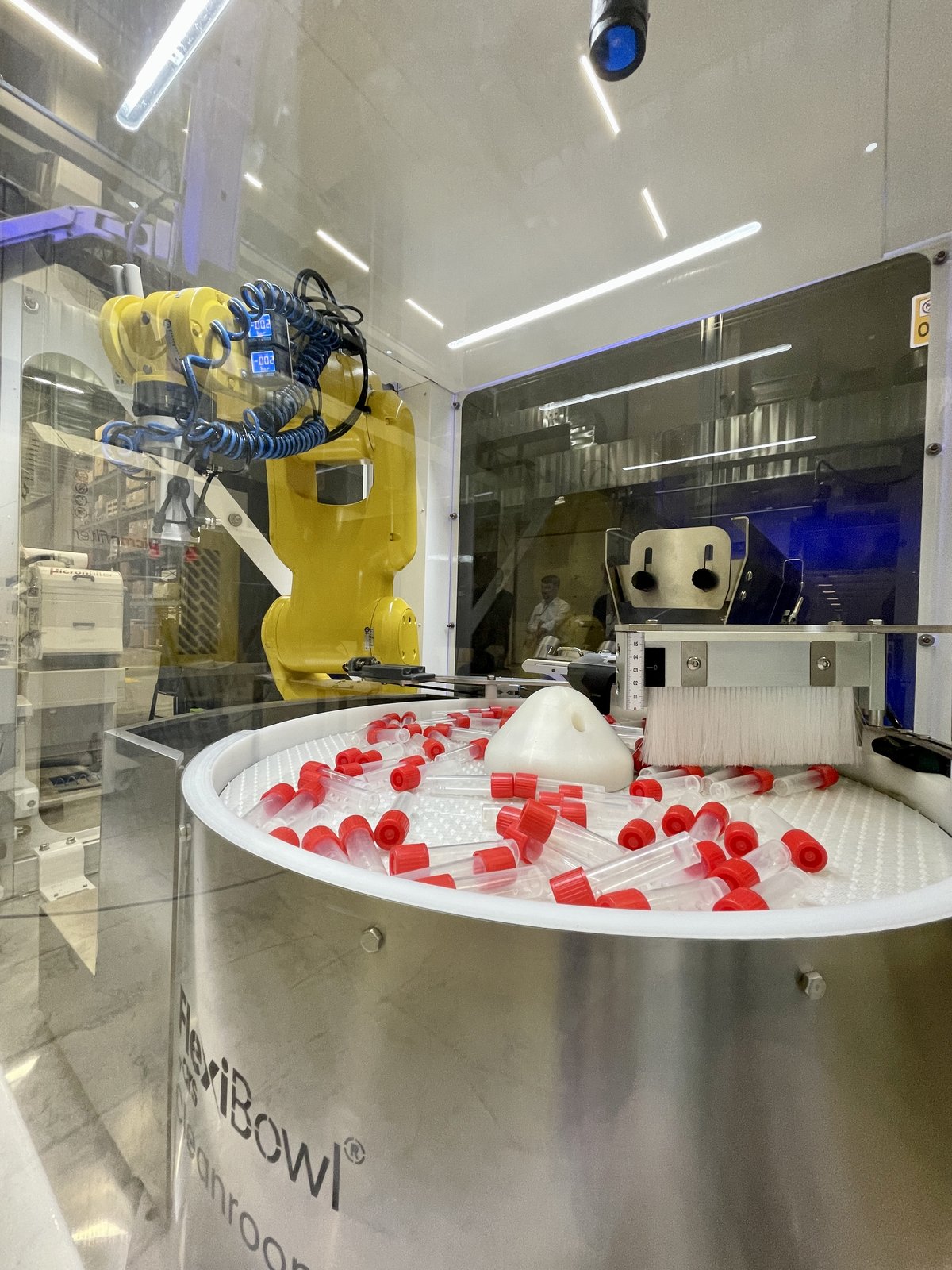
What ARS built instead
ARS combined a FlexiBowl with Epson SCARA robots in a fully automated cell purpose-built for this part. Rather than forcing the tube and cap through a fixed mechanical path, the disc’s alternating rotation and pulse motion spread the parts out and separate them from each other, and vision identifies which ones are lying in a pickable orientation before the robot commits to a pick.
ARS report the result as reliable orientation, gentle handling, and jam-free feeding of the assembly, with no tooling cut specifically for this one part. That last point matters as much as the reliability: a vibratory solution for this part would need a track engineered around its exact geometry, and a small design change to the tube or cap would mean cutting a new one.
- Gentle handling. No mechanical track forcing the tube through a fixed path, so the silicone is not stressed or deformed in transit.
- Reliable orientation. Vision confirms a pickable orientation before the robot moves, rather than relying on mechanical rejection of bad orientations.
- Jam-free feeding. The lace and tube are free to separate and resettle between disc pulses instead of being forced past a chokepoint.
Why this matters beyond blood-line circuits
The part in this case study happens to be a medical consumable, but the underlying problem, a flexible element attached to a rigid one, moving unpredictably in bulk, shows up constantly: cable and connector assemblies, tubing with fittings, anything with a lace, tie or lanyard. If your part has two materials of very different stiffness joined together, this is the class of problem FlexiBowl was built for.
ARS Automation is the manufacturer of FlexiBowl and the wider FlexiVision One vision system; you can read more about the company at arsautomation.com. Comtec is their authorised distributor for Australia, covering sales, application engineering, commissioning and ongoing technical support from Melbourne, Sydney and Adelaide.
If your part has a similar mix of flexible and rigid elements, the fastest way to know whether this applies to you is to test it. Full FlexiBowl specifications and the model range are on our FlexiBowl flexible feeding page, and more medical and pharmaceutical examples are on our FlexiBowl applications page.