How FlexiBowl Creates Reliable Automation for the Most Difficult Parts
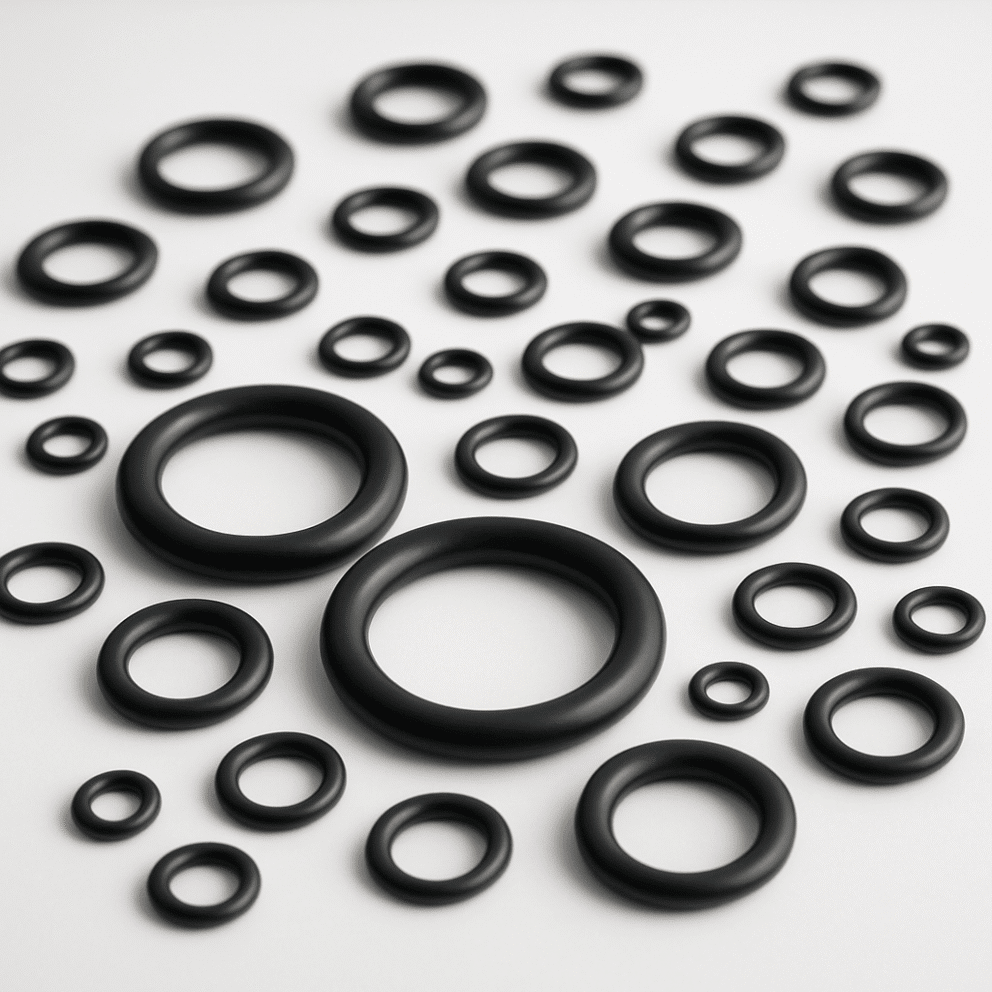
Small, soft, and flexible. O-rings look simple, yet anyone working in automated assembly knows they are one of the toughest components to feed reliably.
Across Australia, manufacturers in medical devices, automotive, hydraulics, plastics, and food equipment rely on O-rings for critical sealing performance. When production stops because an O-ring stuck, folded, or jammed, efficiency drops immediately.
This is exactly where FlexiBowl provides a practical, stable and repeatable solution.
Why Traditional Feeding Systems Struggle with O-Rings
Rigid part feeders work well only when components behave like small hard objects. O-rings are the opposite.
Key challenges include:
• Soft and elastic behaviour O-rings deform, absorb vibration, and bounce unpredictably.
• Tendency to overlap and tangle Clusters form easily when parts come from bulk.
• Circular geometry Traditional linear tracks cannot reliably orient or separate them.
• Frequent jams and stoppages Mechanical channels are easily blocked which forces operators to intervene.
In fast Australian production environments even short stoppages reduce throughput and increase labour cost.
How FlexiBowl Solves the O-Ring Feeding Problem
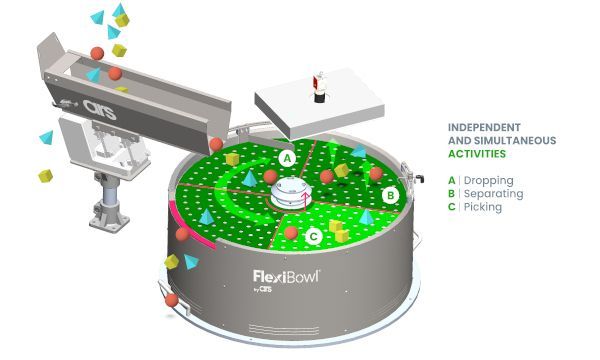
FlexiBowl takes a different approach. Instead of shaking or forcing parts through narrow tracks, it uses controlled movement to spread and separate O-rings gently.
How it works:
• Rotation plus impulse This spreads O-rings across a flat surface so they land individually rather than in clumps.
• Vision guidance A camera identifies O-rings that are correctly oriented and ready for picking.
• Robot integration Any industrial robot can pick with high accuracy once vision sends the coordinates.
• Software driven control Recipes manage O-ring size changes, material types, and speed settings without any mechanical adjustments.
This combination provides predictable, jam free and operator friendly feeding performance.
Benefits for Australian Manufacturers
Gentle on soft materials
No mechanical tracks means no stretching, tearing, or deformation of silicone, Viton or rubber O-rings.
Reliable separation
The controlled impulse avoids tangling and overlapping.
Full flexibility across O-ring ranges
Switch between sizes or materials within seconds using simple software recipes.
Improved quality
Vision ensures only correctly oriented O-rings are sent to the robot which reduces waste and rework.
Faster changeovers
Ideal for Australian manufacturers who run multiple SKUs or short production batches.
True continuous feeding
FlexiBowl keeps the line moving whether you need hundreds or thousands of O-rings per hour.
Q: Can FlexiBowl handle sticky or oily O-rings?
Yes. The system performs well with lubricated O-rings because the impulse-rotation motion separates them effectively.
Q: Does FlexiBowl support clean room or medical environments?
Yes. FlexiBowl can be used with various robot brands including Stäubli which offers hygienic and clean room models commonly used in Australian pharmaceutical and medical device manufacturing.
Q: What sizes of O-rings can be handled?
Everything from very small micro O-rings up to large diameter ones can be managed simply by adjusting recipes.
Q: Can it be integrated with any robot?
Yes. FlexiBowl integrates with ABB, Stäubli, Fanuc, UR, Omron, Kuka, Yaskawa and more.
Q: Do I need a bulk feeder?
Most applications include a hopper but the system can also be supplied with existing feeding equipment depending on your layout.
Talk to Comtec Australia
Every project has different constraints such as cycle time, surface finish requirements, robot model, or available floor space. Our automation engineers can help you define the best configuration for your line.