Manufacturers looking at autonomous pallet handling usually run into the same problem: standard AGVs can move material, but they often fall short when a process needs true forklift capability in a tight footprint. That is where the Staubli FL1500 stands out. It brings forklift function, compact dimensions and industrial mobile robot design into a single platform.
What the FL1500 is designed to do
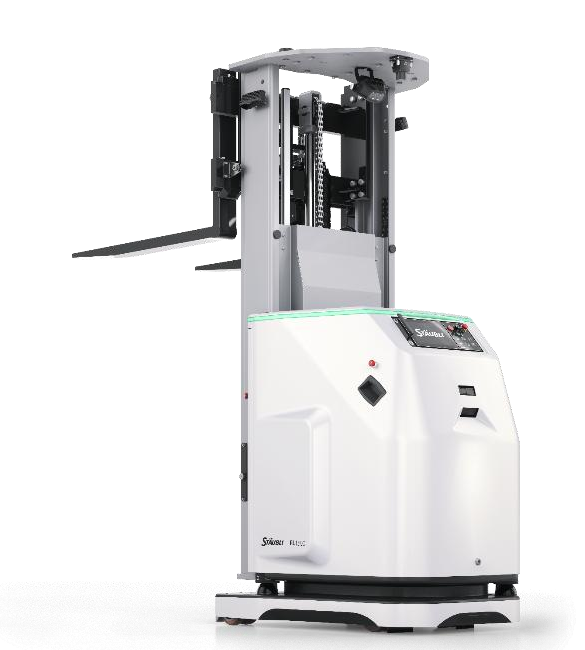
Staubli describes the FL1500 as an ultra-compact 1.5-ton counterbalanced forklift mobile robot. In practical terms, that means it is aimed at operations that need autonomous pallet pick-up, pallet put-away and internal material transfer without giving up the flexibility of a forklift format.
Staubli also positions the FL1500 as a robot for both production and intralogistics, not just warehouse transport. That is an important distinction. The target use case is not limited to back-of-house pallet movement. It also includes machine supply, staged WIP transport and line-side logistics where uptime and repeatability matter.
Why it stands out in factory logistics
One of the clearest official advantages is footprint. Staubli states that the FL1500 offers the smallest counterbalanced footprint on the market at 1,252 x 1,000 mm. For plants working around narrow aisles, existing rack layouts or legacy traffic routes, that is not a minor specification. It directly affects whether an automation project can fit into the current building without major layout changes.
Compact footprint
A smaller counterbalanced footprint gives the FL1500 a stronger fit for constrained warehouse and production environments where turning space is limited.
Production-ready design
Staubli frames the unit as ready for both intralogistics and production operations, which supports broader use than simple point-to-point transfer.
No floor renovation investment
The official positioning emphasises operation without extra floor renovation investment, helping reduce project friction in brownfield sites.
Modular configuration
Battery and counterweight modularity make it easier to align the machine to operating windows, payload needs and application constraints.
Staubli also highlights industrial-grade components and a patented drive unit. That combination points to the same commercial message: this is not a lightweight demo platform. It is intended for long-term industrial use, where availability and predictable serviceability are more important than novelty.
Safety, software and maintainability
For any mobile robot project, the biggest technical discussion is rarely payload alone. It is integration, safety and how quickly a system can be returned to operation if something goes wrong. Staubli addresses all three directly in the FL1500 positioning.
- Human safety scanner
- Three emergency stop buttons
- LED strip for visible status communication
- Floor spot and collision avoidance features
- Monitoring of position accuracy
On the software side, Staubli promotes an open software architecture with modern interfaces and readiness for integration with different fleet and navigation software. That is a key point for manufacturers that do not want to be boxed into a single closed environment as their automation roadmap grows.
Maintenance is another critical. Easy component access, quick replacement of critical parts and faster return to operation. That is the kind of language operations teams pay attention to, because serviceability often determines whether automation continues to add value after commissioning.
Where it fits in real operations
Staubli presents the FL1500 in inbound, warehouse and outbound flows, alongside broader mobile robot applications in production and assembly environments. The warehouse use case is especially clear: pallets can be delivered by other mobile platforms to pallet stations, then the FL1500 takes over for rack storage. That points to a layered automation strategy rather than treating one vehicle as the answer to every movement.
Outbound handling is also notable. Staubli shows the FL1500 picking up pallet cages from the floor and stacking them. That indicates the machine is relevant not only where goods need transport, but where pallet presentation and forklift-style lift action are essential.
In practice, that makes the FL1500 a strong fit for operations such as:
- Autonomous pallet transfer between staging areas and racks
- Line-side replenishment where space is restricted
- Production logistics linking conveyors, stations and warehouse zones
- Automated inbound and outbound pallet flow
- Brownfield factory upgrades where a compact footprint is critical
Why it matters for Australian manufacturers
In Australia, forklift automation decisions are usually shaped by labour efficiency, safety expectations, floor space and the cost of disruption during implementation. A mobile forklift only becomes commercially interesting if it can be integrated without turning the site upside down. That is where the FL1500’s footprint, modular set-up and open integration story become commercially relevant.
For local manufacturers, the right evaluation is not whether an AGV forklift is impressive. It is whether it can reduce non-value manual transport, improve flow consistency and support expansion without creating a service burden. The FL1500 is best understood through that lens.
For plants already investing in robotics, conveyors, machine loading or automated intralogistics, a mobile forklift like the FL1500 can act as part of a wider automation architecture rather than a one-off machine purchase.
Looking at AGV forklifts for your site?
Comtec Australia can help assess whether a compact mobile forklift such as the Staubli FL1500 fits your pallet flow, aisle constraints and automation roadmap.
Talk to Comtec